Stamp Duty Victoria: A Complete Guide for First Home Buyers
Stamp Duty Victoria: A Complete Guide for First Home Buyers
If you’re buying your first home in Victoria, stamp duty is probably the cost that’s caught you slightly off guard. Everyone talks about saving a deposit, but far fewer people mention that stamp duty officially called land transfer duty can add tens of thousands of dollars to what you need at settlement, on top of that deposit.
The good news is that Victoria offers genuine relief for first home buyers, and depending on what you’re buying and for how much, you could pay nothing at all. This guide breaks down exactly how stamp duty works in Victoria, what you’ll actually pay at different price points, and how to make sure you’re not leaving an exemption on the table.
What Is Stamp Duty in Victoria?
Stamp duty is a one-off state government tax charged whenever property ownership changes hands. In Victoria, it’s formally known as land transfer duty, administered by the State Revenue Office (SRO), and it’s calculated as a percentage of your property’s dutiable value generally the purchase price, or market value if that’s higher.
Unlike your deposit, stamp duty isn’t something you can borrow against in the usual sense. It’s typically paid by your conveyancer or solicitor at or before settlement, which means it needs to be sitting in your budget as genuine upfront cash, separate from your loan.
Why the Rate Isn't a Flat Percentage
Calculate stamp duty victoria on a progressive scale, similar to income tax brackets. Rather than a single flat rate applied to the whole purchase price, the duty increases in tiers as the property value rises which is part of why two properties $50,000 apart in price can have a meaningfully different duty bill.
How Much Is Stamp Duty in Victoria?
The exact figure depends on price, buyer type and whether any concessions apply, but here’s a general sense of standard (non-first-home-buyer) duty at common Melbourne price points, compared with what an eligible first home buyer would pay:
| Purchase Price | Standard Duty (approx.) | First Home Buyer Duty |
|---|---|---|
| $600,000 | ~$31,070 | $0 (full exemption) |
| $650,000 | ~$34,000 | ~$12,000 (sliding concession) |
| $700,000 | ~$37,070 | ~$24,747 (sliding concession) |
| $750,000+ | Full standard rate applies | Full standard rate applies |
- These figures are indicative and can shift slightly with individual circumstances, so always confirm your exact number through the SRO's calculator or with your broker before exchanging contracts.
First Home Buyer Stamp Duty Exemption and Concession in Victoria
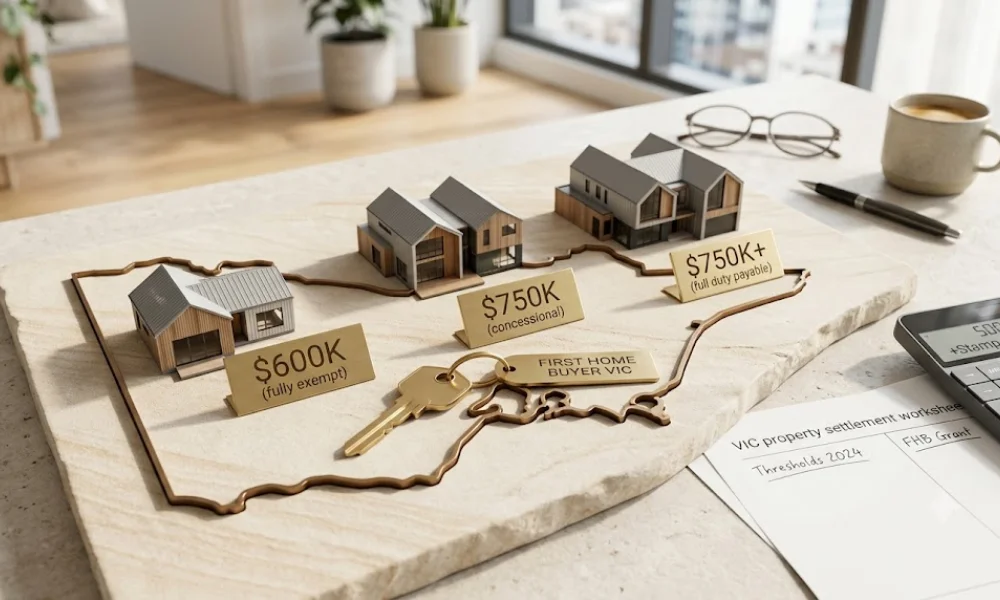
This is the part most first home buyers are really searching for, and it comes down to three clear price bands.
Full Exemption: Properties Up to $600,000
If your dutiable value is $600,000 or less, you pay zero stamp duty. This threshold has stayed unchanged since 1 July 2017, which means it hasn’t kept pace with Melbourne’s median house price but it still captures a genuine slice of units, townhouses and outer-suburb houses.
Sliding Concession: $600,001 to $750,000
Between these figures, the duty tapers gradually rather than jumping straight to the standard rate. The closer you sit to $600,000, the bigger the saving; the closer to $750,000, the smaller it becomes.
Standard Duty: Over $750,000
Above $750,000, there’s no first home buyer concession at all you pay the same rate as any other owner-occupier or investor at that price point.
Am I Eligible for the First Home Buyer Stamp Duty Concession?
To qualify, according to SRO Victoria, you generally need to meet all of the following:
- You (and any co-buyer or spouse/partner) have never owned or co-owned residential property in Australia for a continuous period of six months or more
- You’ll move into the property as your principal place of residence within 12 months of settlement
- You’ll live there continuously for at least 12 months
- At least one buyer is an Australian citizen or permanent resident
- All buyers are enrolled to vote in Victorian elections
A common trip-up: if your partner has owned property before even if you personally haven’t you may both be disqualified, since eligibility is assessed jointly for couples, including de facto relationships.
How to Calculate Stamp Duty in Victoria
Working out your figure comes down to a simple sequence:
- Establish the dutiable value usually your purchase price, or the market value if higher
- Check which threshold band you fall into full exemption, sliding concession, or standard rate
- Apply any relevant concession first home buyer, off-the-plan, or principal place of residence, where eligible
- Confirm with a calculator or conveyancer the SRO’s online calculator gives the most accurate figure for your specific purchase
Because so much of the search demand around this topic is calculator-driven, it’s worth bookmarking the SRO calculator directly rather than relying on rough estimates from a blog including this one.
Stamp Duty vs the First Home Owner Grant: What's the Difference?
These two are easy to conflate, but they work in opposite directions. Stamp duty concessions reduce a cost you’d otherwise pay at settlement. The First Home Owner Grant (FHOG) is a separate $10,000 cash payment from the Victorian Government for eligible buyers purchasing a new home valued up to $750,000 and it’s paid on top of, not instead of, any stamp duty saving.
If you want the full detail on grant eligibility, timing and how to apply, our First Home Owner Grant Victoria guide covers that separately.
The Off-The-Plan Stamp Duty Concession (Bonus Savings)
If you’re considering a new apartment or townhouse, there’s a further concession worth knowing about. For eligible off-the-plan purchases in a strata subdivision, construction costs incurred after your contract date can be deducted from the dutiable value sometimes bringing a property priced above $600,000 back under the exemption threshold entirely.
This concession has an eligibility window tied to contract signing dates, and the exact cut-off has been extended more than once through recent state budgets, so it’s genuinely worth confirming the current date directly with the SRO or your broker rather than relying on a fixed date here.
Common Mistakes First Home Buyers Make With Stamp Duty
- Assuming the exemption applies automatically it doesn’t; you need to apply and meet every eligibility condition, not just the price threshold.
- Forgetting a partner’s history counts one previous owner in the relationship can disqualify both buyers.
- Budgeting stamp duty as an afterthought it needs to be planned alongside your deposit, not discovered a week before settlement.
- Missing the off-the-plan concession buyers often don’t realise a slightly higher-priced off-the-plan purchase could still land under the exemption threshold after construction cost deductions.
- Using outdated figures thresholds and concessions have shifted with recent budgets; always check the current settings before relying on last year’s numbers.
How a Mortgage Broker Helps You Plan for Stamp Duty
Stamp duty catches people out not because it’s a secret, but because it’s easy to underestimate while you’re focused on saving a deposit. Part of preparing a client for pre-approval is working through total upfront costs together deposit, stamp duty, LMI where relevant, and settlement fees so there are no last-minute surprises. If you’re weighing up whether a broker or your bank is better placed to walk you through this, our mortgage broker vs bank guide explains the difference.
Final Thoughts
Stamp duty victoria is one of the largest upfront costs in buying a home, but for eligible first home buyers, it’s also one of the most meaningful areas of genuine government support potentially saving you tens of thousands of dollars if you understand the thresholds before you start making offers. Check where your target price sits against the $600,000 and $750,000 bands early, and factor the figure into your budget from day one rather than treating it as a settlement-day surprise.
Book a free consultation with Eagle Home Loans, and we’ll map out your full upfront costs deposit, stamp duty and grants included before you start house hunting.
Explore Our Home Loan Services
Eagle Home Loans provides tailored finance solutions to help you make confident, informed decisions, no matter where you are in your property journey. If you’re purchasing your first property, our first home loans service can guide you through grants, deposits and the entire buying process. If your current loan no longer suits your needs, we can help you explore refinancing options to secure a better rate, or a loan restructure to make your repayments more manageable. For those looking to grow their wealth, we offer property investment loans, and for business owners, we provide business loans and commercial loans tailored to your goals. If you’re managing multiple debts, our debt consolidation service can simplify your finances into one manageable repayment, and if you’re building your dream home, our construction loans can support you from land purchase through to completion. Whatever your situation, our experienced team is here to help you find the right solution. Contact us to book your free consultation.
Serving Melbourne's Western Suburbs
Eagle Home Loans is proudly based in Williams Landing, making it easy for local home buyers, investors and homeowners to access personalised mortgage advice from an experienced team that understands the local property market. While our office is located in Williams Landing, we proudly provide mortgage broking services to clients across Point Cook, Werribee, Tarneit, Truganina, Hoppers Crossing, Wyndham Vale and Laverton, helping first home buyers, growing families, investors and homeowners secure suitable finance solutions throughout Melbourne’s western suburbs. Whether you prefer an in-person consultation, a phone call or an online meeting, we’re here to make your home loan journey as simple and stress-free as possible. Contact us to book your free consultation.
FAQs – Stamp Duty Victoria Complete Guide
How much is stamp duty in Victoria?
It depends on price and buyer type, but a first home buyer pays $0 up to $600,000, a reduced amount up to $750,000, and standard rates above that.
What is the stamp duty exemption threshold for first home buyers in Victoria?
Properties valued at $600,000 or less qualify for a full exemption; a sliding concession applies up to $750,000.
Is stamp duty the same as the First Home Owner Grant?
No, Stamp duty is a cost you may reduce or avoid; the FHOG is a separate $10,000 payment for eligible new-home buyers.
Can I use a stamp duty calculator for Victoria to get an exact figure?
Yes, the State Revenue Office offers an official calculator that gives the most accurate figure for your specific purchase.
Do I need to apply for the first home buyer stamp duty concession, or is it automatic?
You need to apply and meet all eligibility criteria it isn’t applied automatically just because you’re a first home buyer.
Does my partner's property history affect my stamp duty exemption?
Yes. If your spouse or de facto partner has previously owned property, it can disqualify both of you from the concession.
Is there a stamp duty concession for off-the-plan purchases in Victoria?
Yes, eligible off-the-plan buyers can deduct post-contract construction costs from the dutiable value, which may bring a purchase under the exemption threshold.
When do I actually pay stamp duty in Victoria?
It’s typically paid at or shortly before settlement, arranged by your conveyancer or solicitor as part of the transfer process.
Explore More

Who Qualifies for the First Home Buyers Grant in Victoria?

First Home Buyer Guide Melbourne – 21 Smart Secrets to Buy Your First Home in 2026

First Home Buyers Grant VIC: Eligibility, Amount & How to Apply